Railway Project Engineering and Construction: Regulatory Framework, Layout, Installations and Execution Methods in the ADIF Network
Table of Contents
- Chapter I. Legal Foundation and Technical Governance Framework
- Chapter II. Definition and Concept of Railway Project
- Chapter III. Document No. 1: Report and Annexes
- Chapter IV. Document No. 2: Plans
- Chapter V. Document No. 3: Particular Technical Specifications (PPTP)
- Chapter VI. Document No. 4: Budget
- Chapter VII. Document No. 5: Work Schedule
- Chapter VIII. Conclusion
- Review Questions
- Bibliography
Railway infrastructure in the Spanish State represents one of the nation’s most complex and strategic assets, whose management, maintenance and expansion are the responsibility of the Administrator of Railway Infrastructures (ADIF) and ADIF High Speed (ADIF AV). The production of technical projects in this sector is not solely an exercise in civil or industrial engineering, but stands as the backbone ensuring operational safety, economic efficiency and technical interoperability within the General Interest Railway Network (RFIG). This report comprehensively analyzes the nature, typology and contents of ADIF projects, based on current technical regulations, the General Project Instructions (IGP) and the General ADIF Standards (NAG).
Chapter I. Legal Foundation and Technical Governance Framework
The development of any action on railway infrastructure is inextricably linked to Law 38/2015 on the Railway Sector and its implementing Regulation, Royal Decree 2387/2004. These legal texts establish that the administration of railway infrastructures includes the planning, construction and maintenance of lines, stations, terminals and other elements necessary for railway operation.1 In this context, the technical project acts as the enabling document that transforms strategic planning into physical reality.
The approval of a project for the delimitation and use of railway spaces by the Ministry of Transport implies the declaration of public utility and the need for occupation of necessary goods, giving the project a legal relevance of the first order in expropriation and land use planning processes.2 Likewise, ADIF’s internal technical regulations, approved by its Standards Committee, ensure that all projects maintain an indispensable technical homogeneity for the network to function as an integrated and safe system.3
| Regulatory Element | Main Function in Project Management | Base Reference |
|---|---|---|
| Law 38/2015 on the Railway Sector | Superior legal framework defining competencies and railway public domain. | 2 |
| RD 2387/2004 (Regulation) | Development of infrastructure management and additional services. | 1 |
| General ADIF Standards (NAG) | Transversal guidelines on content, presentation and project management. | 4 |
| General Project Instructions (IGP) | Sectoral technical specifications (geotechnics, layout, tunnels, etc.). | 5 |
| Technical Specifications for Interoperability (TSI) | European regulations to ensure compatibility of railway systems. | 4 |
Chapter II. Definition and Concept of Railway Project
In the ADIF context, a project is defined as the set of technical documents that exhaustively determine the characteristics of the works or installations to be carried out, technically and economically justifying the adopted solution.4 A fundamental principle is that of “complete work”, meaning the project must define all actions necessary for the infrastructure or installation to be functionally operative after its execution, complying with the safety and reliability objectives that motivated its drafting.4
The project is not only a guide for construction, but a key piece of asset management. It must contemplate not only the execution phase, but also environmental integration, worker safety, management of generated waste and particularities of future maintenance of projected elements.4 This comprehensive vision ensures that the lifecycle of the infrastructure is managed efficiently from the design phase.
Taxonomy of Projects in the ADIF Network
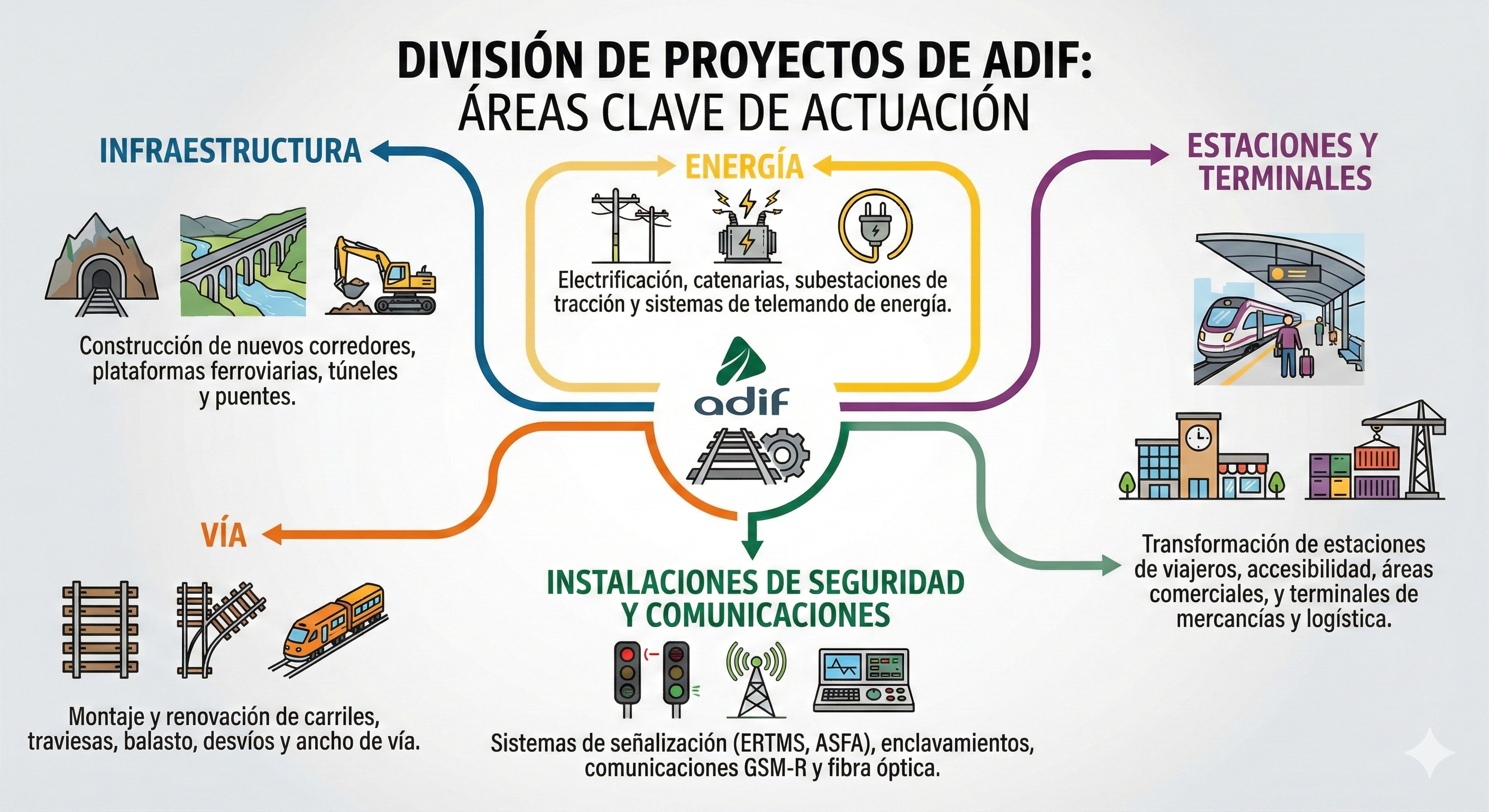
The classification of projects responds to the diversity of assets and the different phases of the construction process. Standard NAG 3-0-0.0 establishes the scope of application for projects affecting infrastructure, track, energy, safety and communications installations, stations and terminals.4
The railway network is divided into subsystems, each with specific technical requirements that must be reflected in the project drafting.
- Infrastructure and Track Projects: Focus on the railway platform, including earthworks, tunnels, viaducts and the superstructure (rails, sleepers, ballast and track apparatus).3 These projects must follow the guidelines of the ADIF Platform Standards (NAP) and the IGPs for geotechnics and hydrology.5
- Energy Projects: Address electrification systems, including the catenary (overhead contact line), traction substations and energy remote control systems.4 Interoperability in this subsystem is critical to allow the circulation of different train types.
- Control, Command and Signalling (CCS) Projects: Are projects of high technological complexity including block systems, interlockings (electrical or electronic) and train protection systems like ASFA or ERTMS.6
- Telecommunications Projects: Define fiber optic networks and mobile railway communication systems (GSM-R) necessary for operation and circulation safety.7
- Railway Building Projects: Refer to stations, freight terminals and technical buildings. These projects are governed by standard NAG 3-0-2.0, adapting the Building Technical Code to the railway environment.6
Types of Projects According to Scope and Development Phase
The progression of a railway action is usually divided into two levels of technical definition: the Basic Project and the Construction Project.3
| Characteristic | Basic Project (or Layout Project) | Construction Project (or Execution Project) |
|---|---|---|
| Objective | General definition, obtaining licenses, expropriations and declaration of public utility. | Detailed definition for the execution of works and tendering. |
| Technical Content | Descriptive report, general plans, global valuation by chapters. | Detailed technical report and annexes, execution plans, specifications, unit budget. |
| Level of Detail | Conceptual and functional. Does not by itself allow the start of work. | Executive. Allows exact construction without additional consultations. |
| Signature Documents | Report, Plans and Valuation. | Report, Annexes, Plans, Specifications and Budget. |
| Reference | 4 | 4 |
Actions in Conventional Network vs High Speed
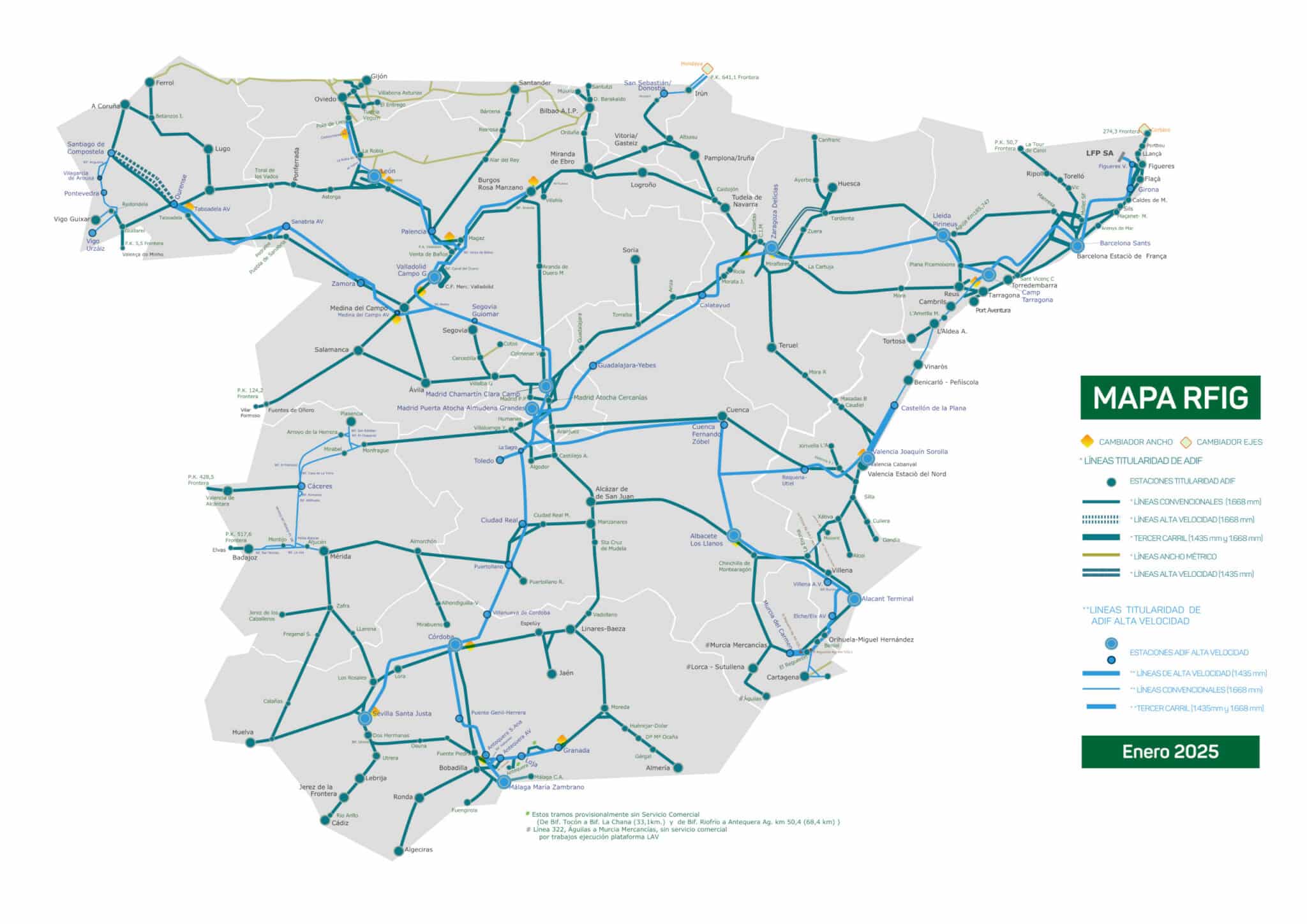
The nature of the project varies significantly depending on whether the action is located in the conventional network (generally Iberian gauge of 1668 mm) or in the high-speed network (standard gauge of 1435 mm).7
In the High Speed Network, projects are strongly conditioned by the Technical Specifications for Interoperability (TSI). Layout parameters (curve radii, maximum gradients) are much stricter to allow speeds of 300 km/h or higher.7 The infrastructure must be designed to withstand greater dynamic forces, and signaling systems are exclusively next-generation (ERTMS).7
In the Conventional Network, projects usually focus on asset renewal, level crossing suppression and reliability improvement.7 There is greater variability in technical parameters due to adaptation to historical layouts and the coexistence of different traction systems (diesel and electric) and signaling.7
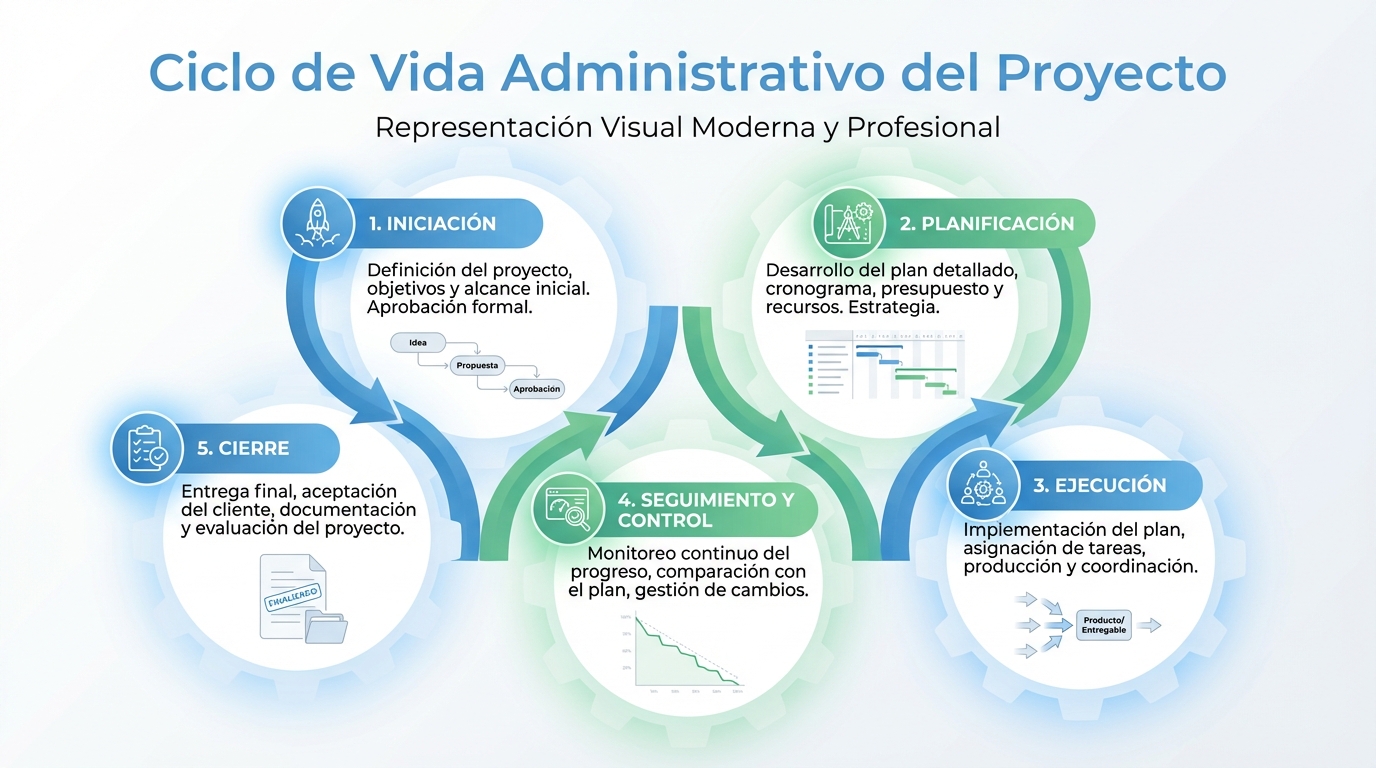
Administrative Lifecycle of the Project
An ADIF technical project must pass several administrative phases before its execution.
- Project Supervision: Supervision Offices verify that the project complies with technical, legal and budgetary regulations. This supervision is mandatory for projects of large amount or structural complexity.4
- Technical Approval: Administrative act by which ADIF validates and assumes the project content for all legal and technical purposes.4
- Staking Out (Replanteo): Before tendering the work, staking out is performed to ensure land is available and the work is viable. After adjudication, the Staking Out Act is signed marking the start of the execution period.1
- Product Validation: If the project incorporates new railway components or materials, these must pass a technical validation process which may include track tests in real environments.3
Chapter III. Document No. 1: Report and Annexes
The Report and its Annexes constitute the intellectual body of the project, where the need for the work is justified, alternatives are analyzed and the technical support for adopted solutions is developed.4
Structure and Content of the Descriptive Report
The Report must present a chronological and logical order allowing any technician external to the project to understand the genesis and development of the solution.4 Mandatory sections include:
- Object of the Project: Clear and concise definition of the purpose of projected works and installations.4
- Administrative and Technical Background: List of investment plans, agreements with city councils or autonomous communities, as well as inspection reports, history of breakdowns or end of useful life of assets justifying the intervention.4
- Current Situation: Description of the state of the infrastructure or installation prior to the action, identifying deficiencies or improvement needs.4
- Description of the Works: Technical summary of the action, detailing the adopted solution and its justification against other possible alternatives.4
- Interoperability: Justification that the project complies with applicable TSIs or, failing that, analysis of non-affection to interoperability parameters.4
- Execution Term: Justification of estimated time for work completion, considering yields and railway operation constraints.4
- Budget: Summary of different economic valuations (PEM, PEC, VEC, PCA).4
Technical Annexes: Scientific Design Support
Annexes are independent documents developing specific aspects of the project. ADIF regulations and IGPs establish a list of required annexes depending on project nature.4
- Cartography and Topography Annex: Defines the geometric basis of the project. Essential to ensure works are correctly located in space and for precise calculation of earth volumes.3
- Geology and Geotechnics Annex: Study of the ground on which the infrastructure sits. Includes laboratory tests, boreholes and recommendations on structure foundations and slope stability.5
- Hydrology and Drainage Annex: Analysis of water behavior in the track environment. Defines sizing of transversal drainage works (culverts, pipes) and longitudinal (ditches) to prevent flooding or platform erosion.3
- Layout Annex: Geometric justification of the track in plan and profile, ensuring compliance with speed, comfort and safety parameters (radii, cants, transitions).3
- Structures Annex: Contains structural calculations for bridges, viaducts, walls and tunnels, justifying material resistance and overall stability.4
- Expropriations Annex: Critical document for territorial management. Includes list of affected goods and rights (RBDA), parcel plans and valuation of compensations.5
- Affected Services and Replacements Annex: Identification of power lines, water pipes, gas networks or third-party telecommunications that must be diverted or protected during work.4
- Interoperability Annex: Mandatory character, this annex must include compliance analysis tables for parameters established in corresponding TSIs.4
- Risk Analysis and Climate Change Adaptation Annex: According to standard NAG 4-0-0.0, evaluates infrastructure vulnerability to extreme weather events and proposes resilience measures.4
- Maintenance Particularities Annex: Describes necessary operations to conserve new assets in optimal conditions during their useful life.4
Environmental Integration and Waste Management
Regulation IGP-6 and the recent NAG 4-0-3.0 establish very strict environmental requirements for railway projects, seeking to minimize ecological and landscape impact.8

Environmental Integration Annex
This annex must incorporate measures dictated by the Environmental Impact Declaration (DIA). Aspects such as aquifer protection, creation of wildlife crossings, slope restoration and acoustic screen installation must be defined with detail plans and own budget.8 A fundamental element is the demarcation of the occupation zone to prohibit machinery access to highly sensitive environmental areas.8
Construction and Demolition Waste Management Study (RCD)
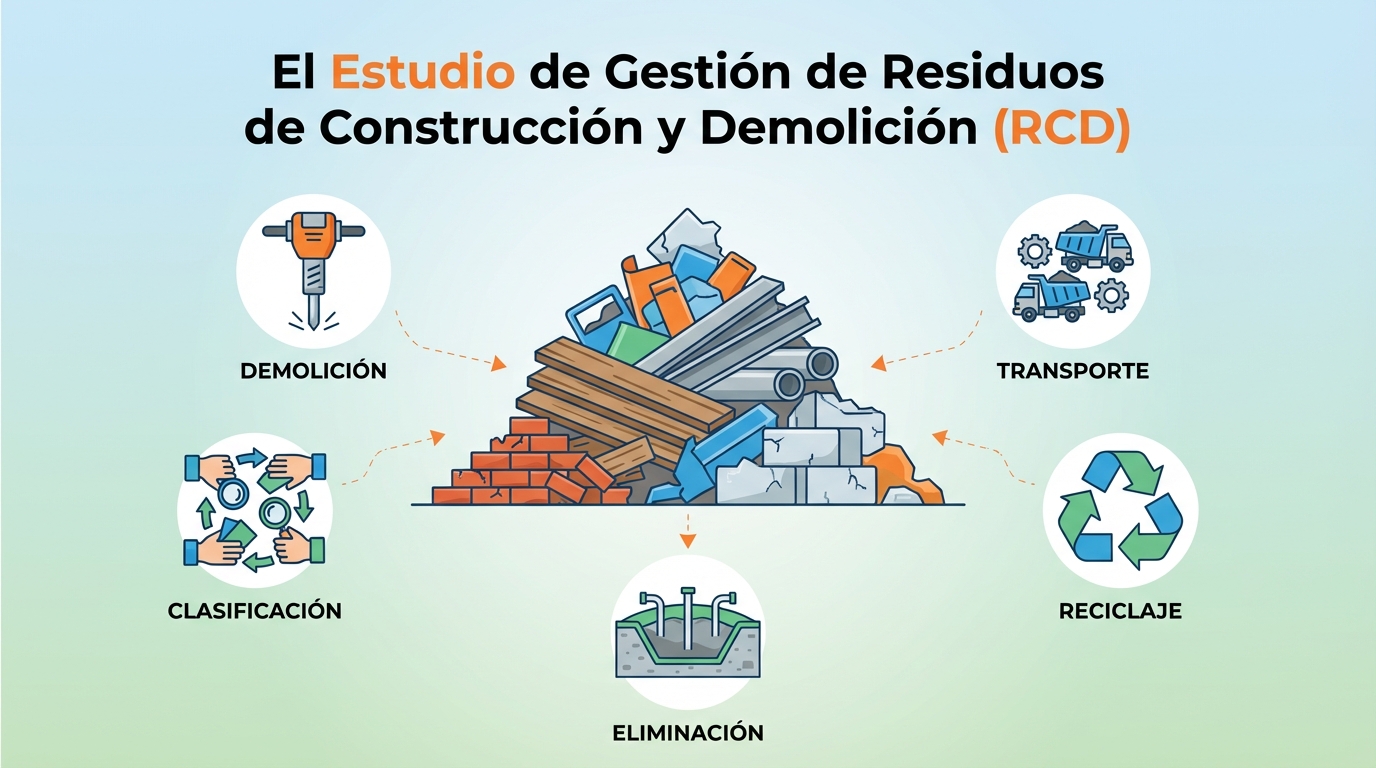
Every project must include a detailed study identifying and quantifying waste that will be generated.9
- Identification: Use of LER codes for each waste (soil, concrete, metal, wood).9
- Estimation: Volume and weight calculation based on project measurements.9
- Valuation: Forecasted cost for management (transport to landfill, dumping fee or plant valorization).9
- Waste with Commercial Value: ADIF pays special attention to materials like rail or old catenary, which can generate revenue from scrap sales, which must be reflected in the study.9

Safety and Health: Standard NAG 7-0-0.0
Safety is the fundamental pillar of the railway system. The Health and Safety Study (ESS) is an integral document within the project seeking to prevent accidents during the construction phase.10
 According to standard NAG 7-0-0.0, the ESS must be a real, complete document adjusted to the work complexity, analyzing specific risks of the railway environment.10
| Special Risk in ADIF | Preventive Measures and Specific Annexes | Reference |
|---|---|---|
| Being run over by trains | Track cut procedures, railway lookout and acoustic signaling. | 10 |
| Electrical contact | Proximity protocols to catenary and high voltage lines; earthing. | 5 |
| Tunnel works | Atmosphere control, forced ventilation and evacuation plans. | 5 |
| Fall from height | Requirements for railings, safety nets and certified scaffolding. | 10 |
| Affected services | Location and signaling of buried signaling and fiber optic cables. | 4 |
The ESS must have its own report, specifications, detail plans and specific budget guaranteeing availability of funds for risk prevention.10
Chapter IV. Document No. 2: Plans
Plans constitute the graphic definition of the project and must possess a level of detail allowing exact measurement of all work units and faithful execution of what is projected without need for additional interpretations.4
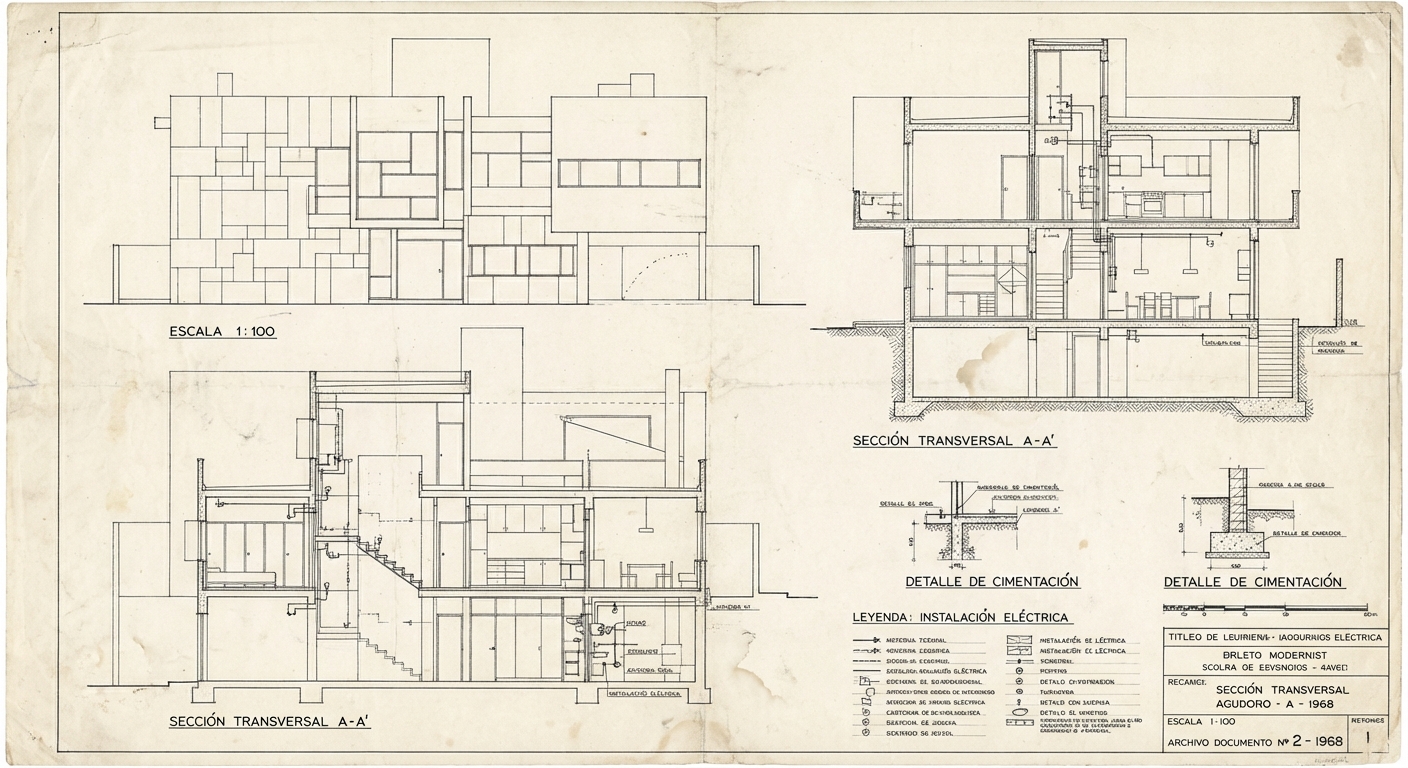
Plan organization must follow a logical structure, starting from general situation plans and evolving to detail plans. Element nomenclature (structures, tunnels, drainage works) must follow a unique reference system adopted by ADIF to facilitate subsequent asset inventory management.3
| Plan Typology | Content and Function | Technical Reference |
|---|---|---|
| Plan and Profile Plans | Geometric definition of track axis and its relation to natural ground. | 4 |
| Standard Sections | Detail of platform layers (ballast, sub-ballast, form layer) and cable troughs. | 5 |
| Structures Plans | Elevations, plans, sections and reinforcement detailing of masonry works. | 4 |
| Installations Plans | Location of signals, catenary posts, ducting and technical buildings. | 7 |
| Parcel Plans | Delimitation of properties affected by work occupation. | 4 |
Implementation of BIM Methodology
ADIF has integrated BIM (Building Information Modeling) methodology as a transversal requirement in its projects to improve design quality and asset management efficiency.6
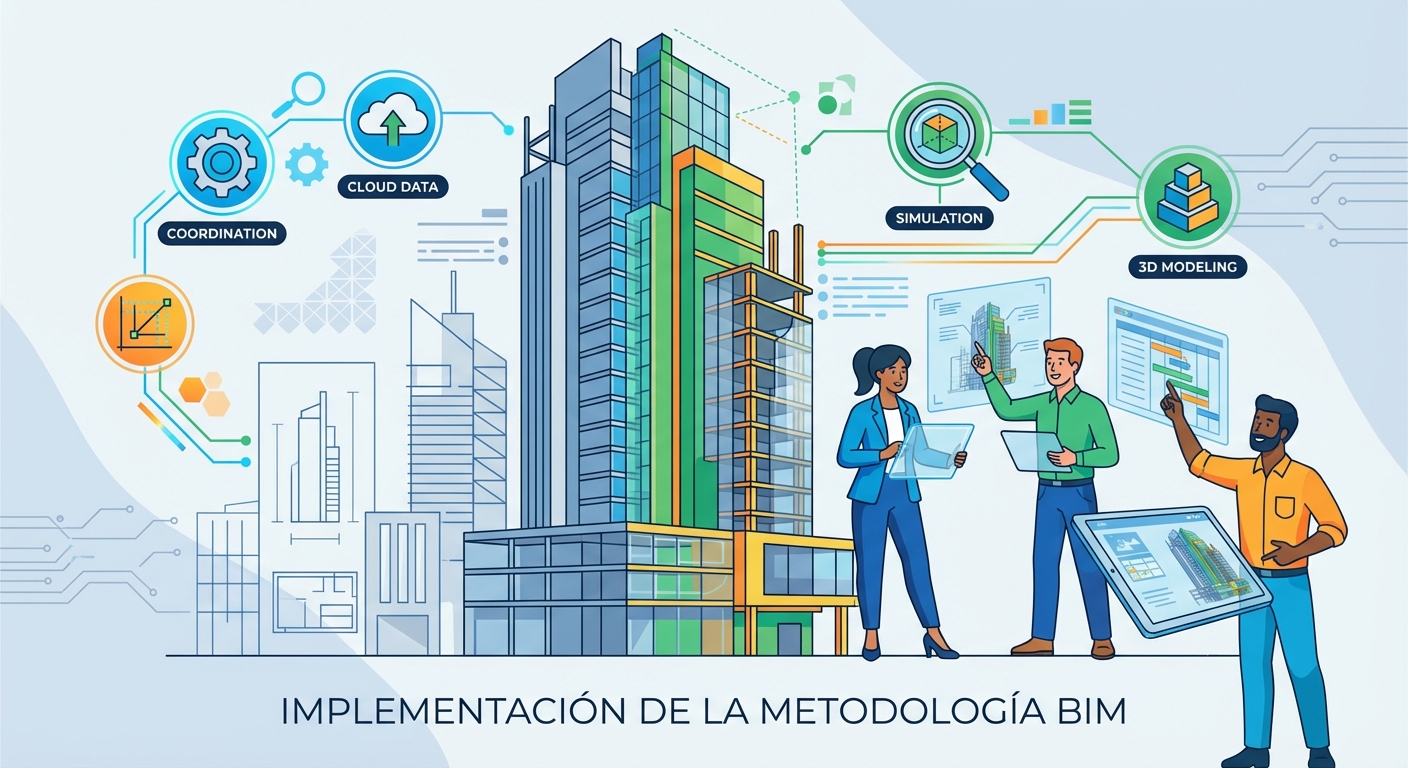 The inclusion of BIM clauses and the drafting of a BIM Execution Plan (BEP) in project annexes allow:
- 3D Coordination: Avoid spatial interferences between different disciplines (e.g., a catenary post interfering with a drainage collector).6
- Information Management: Ensure all technical data of materials and equipment are linked to the digital model for use in maintenance.4
- Visualization and Simulation: Facilitate project understanding and simulate complex construction processes before real execution.6
Chapter V. Document No. 3: Particular Technical Specifications (PPTP)
The Specifications (Pliego) is the contractual document governing the technical relationship between ADIF and the contractor. It defines material quality, execution methods of work units and measurement and payment criteria.6
The PPTP is usually structured in three chapters:
- Chapter I: General Provisions: Applicable technical regulations, Construction Management functions, contractor obligations regarding safety, quality and environment.4
- Chapter II: Description of Works: Detailed description of actions composing the project, establishing work scope.4
- Chapter III: Work Units and Measurement Criteria: The most technical part. Defines for each work unit (e.g., rock excavation, rail supply, switch assembly) material requirements, execution process, necessary quality control tests and how the unit will be measured for payment.4
ADIF has “Standard Specifications” for different specialties (civil works, signaling, telecommunications) serving as a base to draft the particular specification of each project, which must adapt to the singularities of the specific action.6
Chapter VI. Document No. 4: Budget
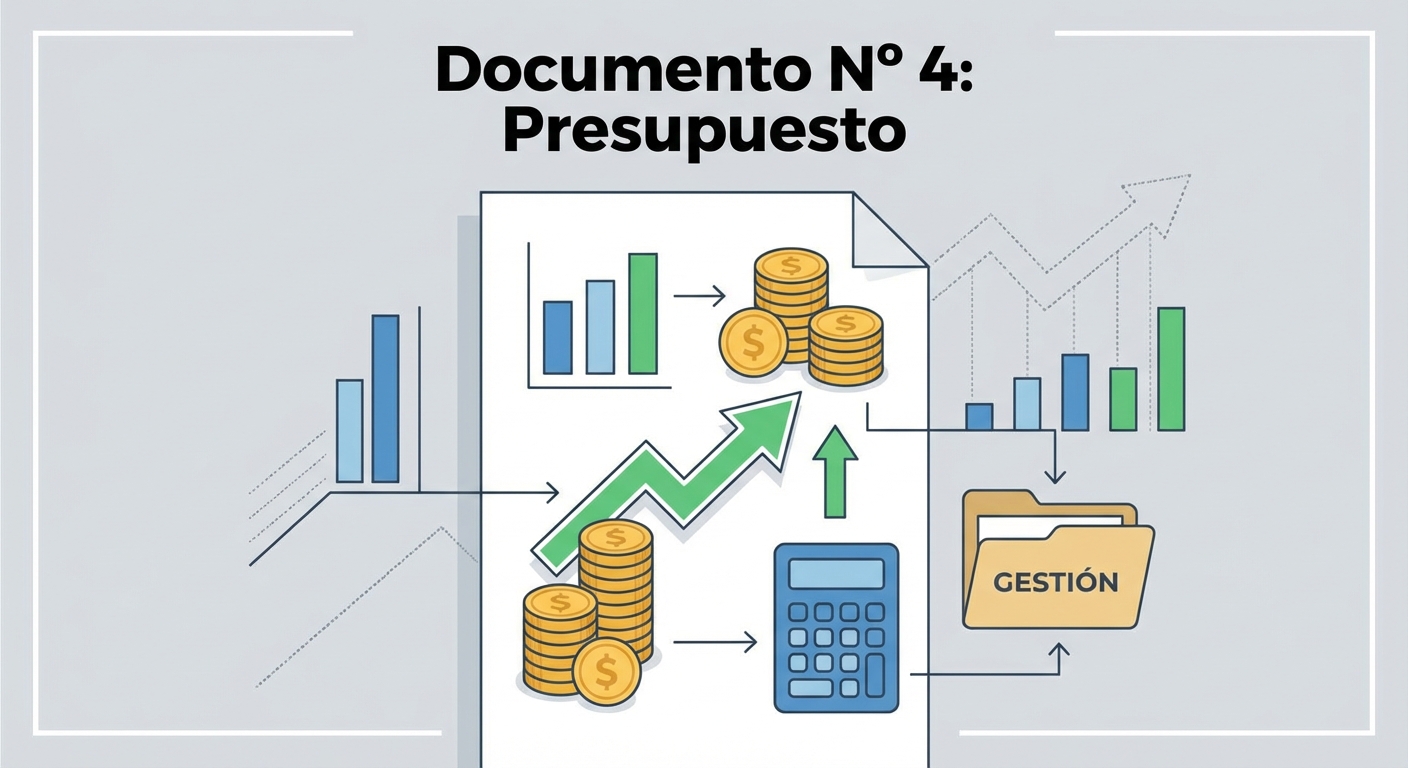
The Budget economically quantifies the project. Its elaboration is based on the ADIF Price Base (BPA), ensuring work valuation consistent with railway sector market prices.6
ADIF Budget Components
The budget is organized hierarchically to allow detailed cost control.
- Measurements: List of quantities of each work unit necessary to complete the project, obtained directly from plans.4
- Price Table No. 1: Unit prices of each work unit, expressed in letters and figures. These are closed prices including all direct and indirect costs.4
- Price Table No. 2 (Decomposed Prices): Breakdown of each unit price into basic components: labor, machinery, materials and indirect costs.4
- Partial Budgets: Economic valuation of each chapter or group of work units.
- Material Execution Budget (PEM): Sum of all partial budgets. Represents net cost of works.4
- Base Tender Budget (PBL): PEM increased with General Expenses (13%), Industrial Profit (6%) and corresponding VAT (21%).4
- Estimated Contract Value (VEC): Includes contract budget plus value of materials ADIF provides to the contractor (external supplies like rail or sleepers).4
- Budget for Administration Knowledge (PCA): Most complete valuation, including VEC plus expropriation costs, technical assistance, control and surveillance and items for historical heritage.4
In projects suffering significant delays between approval and tender, regulations allow unit price updates to reflect raw material cost increases, according to RDL 3/2022.4
Chapter VII. Document No. 5: Work Schedule
The Work Schedule is the document for temporal planning of works. Its relevance in ADIF is maximum due to the need to coordinate work execution with maintenance of railway operation.4
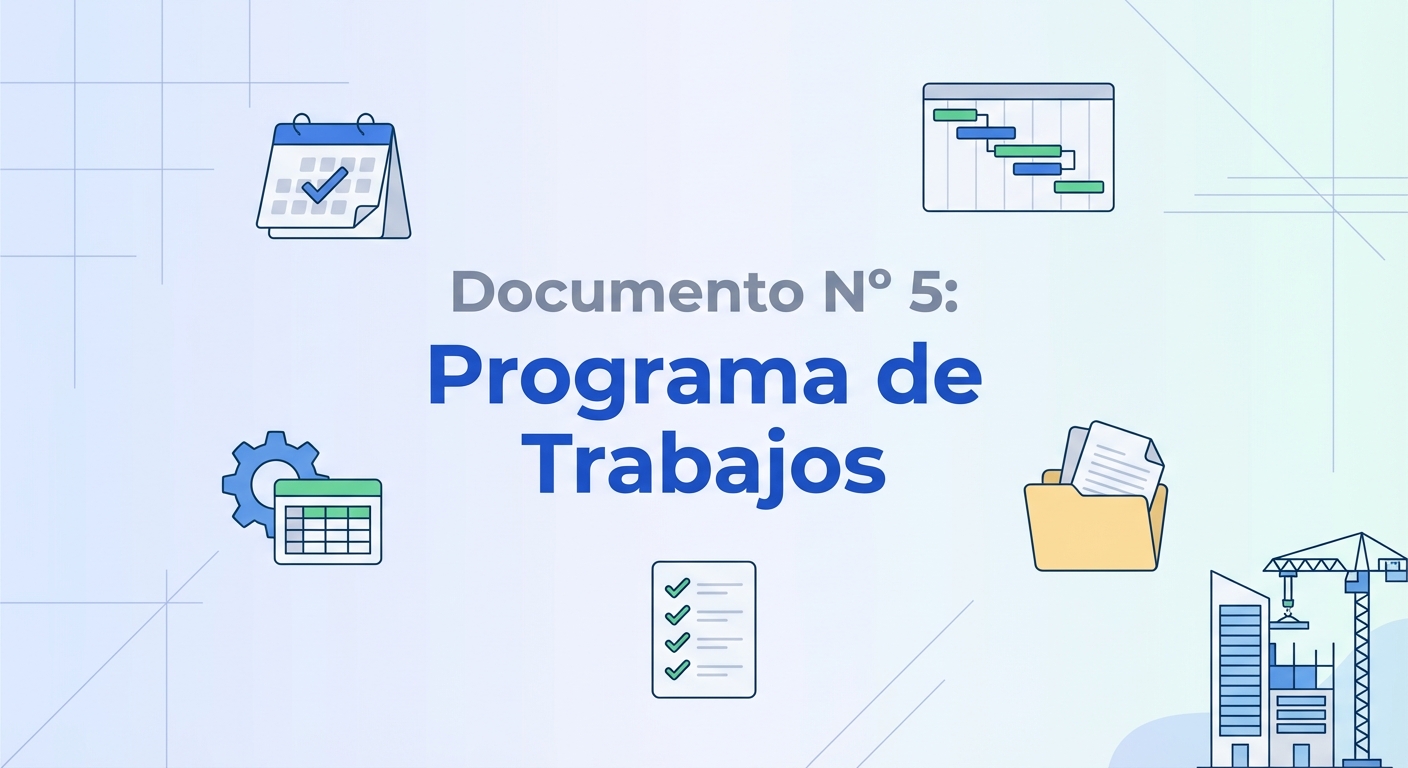 It must include:
- Gantt Chart: Visual representation of tasks, duration and interdependencies in time.4
- Critical Path Method (CPM) Identification: Sequence of tasks determining minimum project duration. Any delay in a critical path task impacts directly on completion date.4
- Framework Operation Plan: Essential document defining time intervals (maintenance bands) in which work can be done, temporary speed limitations and foreseen affection to train circulation. This plan must be coordinated and signed by ADIF Circulation and Infrastructure managers.4
- Project Milestones: Key dates marking end of critical phases or partial commissioning of installations.4
Planning must consider not only work execution itself, but also times necessary for safety tests, personnel training and authorization processes for entry into service by the AESF.5
Chapter VIII. Conclusion
Excellence in ADIF project drafting is a necessary condition for railway transport system modernization. The transition towards smarter, more sustainable and interoperable infrastructure requires technical projects to be documents of maximum precision and scientific quality.
Drafting teams are recommended to place special emphasis on the data collection phase (topography, geotechnics and affected services), as deficiencies in this stage are the main cause of project modifications during construction phase, with consequent cost overruns and delays. Likewise, early integration of BIM methodology and European interoperability requirements ensures projected infrastructure today is competitive and functional for decades to come.
The ADIF project, in its modern conception, transcends the construction plane to become the digital twin of the infrastructure, guaranteeing that every euro invested contributes safely and efficiently to territorial structuring through railways.
Review Questions
What fundamental principle must every ADIF project comply with to ensure its operational functionality?
The principle of “complete work”, implying defining all actions to ensure the infrastructure is functional upon completion.
What are the main differences between a Basic Project or Layout Project and a Construction Project?
The Basic Project defines the general solution to obtain licenses and expropriations, while the Construction Project details work execution for tendering.
What role does the Particular Technical Specifications (PPTP) play in a railway project?
It is the contractual document governing the relationship between ADIF and the contractor, defining material quality and execution methods.
What is the difference between Material Execution Budget (PEM) and Base Tender Budget (PBL)?
PEM is the net cost of works, while PBL includes PEM plus General Expenses (13%), Industrial Profit (6%) and VAT (21%).
What essential document of temporal planning defines operational intervals for working on the track?
The Framework Operation Plan, which establishes maintenance bands and impact on train circulation.
Bibliography
-
Royal Decree 2387/2004, of December 30, approving the Railway Sector Regulation. https://www.boe.es/buscar/act.php?id=BOE-A-2004-21908 ↩ ↩2 ↩3
-
Law 38/2015, of September 29, on the Railway Sector. https://www.boe.es/buscar/act.php?id=BOE-A-2015-10444 ↩ ↩2
-
ADIF. Technical Regulations Catalog. https://www.adif.es/documents/20124/3371563/CatalogoNormativaTecnica.pdf ↩ ↩2 ↩3 ↩4 ↩5 ↩6 ↩7 ↩8
-
ADIF. NAG 3-0-0.0: Index and Standard Content of Projects. https://www.adif.es/documents/20124/12858981/NAG3000_ED2_FC2.pdf ↩ ↩2 ↩3 ↩4 ↩5 ↩6 ↩7 ↩8 ↩9 ↩10 ↩11 ↩12 ↩13 ↩14 ↩15 ↩16 ↩17 ↩18 ↩19 ↩20 ↩21 ↩22 ↩23 ↩24 ↩25 ↩26 ↩27 ↩28 ↩29 ↩30 ↩31 ↩32 ↩33 ↩34 ↩35 ↩36 ↩37 ↩38 ↩39 ↩40 ↩41 ↩42 ↩43 ↩44 ↩45 ↩46 ↩47 ↩48
-
ADIF. Management System: General Instructions for Projects (IGP). https://www.seguridadferroviaria.es/recursos_aesf/D249FA7C-291F-473C-B884-4A54BEC241FB/144028/012IGP2008_AESF.pdf ↩ ↩2 ↩3 ↩4 ↩5 ↩6 ↩7 ↩8
-
ADIF. Technical Regulations and BIM Methodology. https://www.adif.es/empresas-y-contratacion/normativa-tecnica ↩ ↩2 ↩3 ↩4 ↩5 ↩6 ↩7 ↩8
-
Polytechnic University of Catalonia. High Speed Lines vs Conventional Lines. https://upcommons.upc.edu/bitstreams/f107571b-2a9d-4f5a-848a-ec0a31a9593d/download ↩ ↩2 ↩3 ↩4 ↩5 ↩6 ↩7
-
ADIF. IGP-6: Environment in Infrastructure Projects. https://es.scribd.com/document/651797462/IGP-6-Medio-Ambiente-ADIF ↩ ↩2 ↩3
-
ADIF. NAG 4-0-3.0: Construction and Demolition Waste Management Study (RCD). https://www.adif.es/documents/20124/35603770/NAG4030_ED1_FC1.pdf ↩ ↩2 ↩3 ↩4 ↩5
-
ADIF. NAG 7-0-0.0: Drafting of Health and Safety Studies. https://www.adif.es/documents/20124/16317284/NAG7000_ED2_FC1.pdf ↩ ↩2 ↩3 ↩4 ↩5